How to Choose a Commercial Cleaning Company in Boston: The 12-Point Checklist
Choosing a commercial cleaning company in Boston is one of the more consequential vendor decisions a business owner makes — and one of the most rushed. The wrong choice means missed cleanings, employee complaints, surprise charges, security issues, and contracts you can't get out of. The right choice quietly disappears into the background of your operations and makes your office consistently better.
The problem is that almost every commercial cleaning company says the same things on their website: "reliable, professional, eco-friendly, fully insured." So how do you actually tell them apart before signing a contract? You ask the right questions, look at the right paperwork, and watch for the small signals that separate a real operation from a sales pitch.
This 12-point checklist is built specifically for businesses hiring janitorial services in Boston, Cambridge, Quincy, and the broader Greater Boston area. Walk through each step before you commit, and you'll avoid 95% of the bad outcomes we hear about from clients who switched to us from a previous provider.
Why the Right Cleaning Partner Matters More Than You Think
Commercial cleaners have keys, alarm codes, and after-hours access to your entire facility. They handle confidential paperwork left on desks, expensive equipment, and in some cases controlled spaces with regulated information. The decision isn't just "who vacuums the floors" — it's "who do we trust inside the building when no one else is here?"
On top of that, cleaning quality directly affects your employees' health and your clients' first impression. CDC NIOSH research ties indoor environmental quality directly to absenteeism and productivity. A cheap cleaner who cuts corners on disinfection isn't saving you money — they're moving the cost into sick days, allergy complaints, and lost meetings.
Treat this like onboarding a vendor with after-hours building access, because that's what it is. The 12 steps below are how you do that properly.
1. Verify Insurance, Bonding, and Workers' Compensation
What to ask for: a current Certificate of Insurance (COI) with your business listed as an additional insured. The COI should show three things: general liability (typically $1M per occurrence / $2M aggregate is the commercial standard), a surety bond covering theft and dishonesty, and active workers' compensation for every cleaner who will set foot in your building.
Why it matters: If a cleaner slips and gets hurt in your office and the company doesn't carry workers' comp, your business can be liable. If a laptop goes missing and there's no bond, your only recourse is small-claims court against a company that may dissolve. If a chemical spill damages a tenant's space and there's no liability coverage, you'll be writing the check.
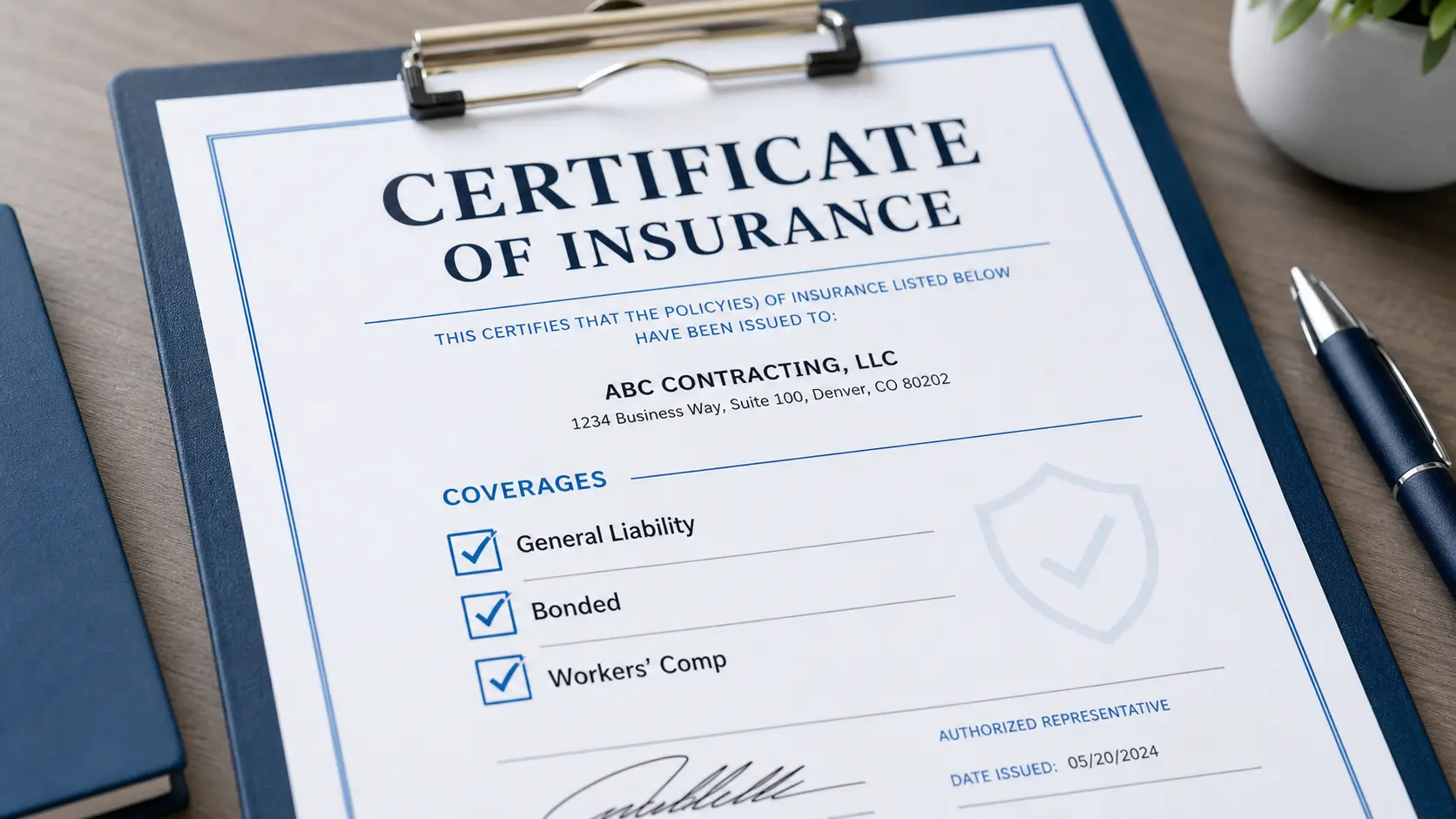
The red flag: any company that hesitates, says "I'll send it later," or only emails a screenshot. A legitimate operator can request an updated COI directly from their broker and have it in your inbox within an hour. Massachusetts requires workers' compensation for nearly all employers — there is no excuse for a cleaning company not to have it.
2. Check Years in Business and Local Boston Experience
What to ask for: how long the company has been operating, how long under the current ownership, and how many Boston-area accounts they currently service. A company that's been around three years with steady local clients is often a better partner than a fifteen-year-old company that just changed hands and is rebuilding its team.
Why local matters: Boston has its own quirks. Old buildings with finicky HVAC, freight elevators with strict hours, snow and salt tracked into lobbies all winter, building management offices that issue access cards. A cleaner who already works buildings on Boylston Street, in the Seaport, or around Kendall Square has solved these problems before. A national franchise doing its first month here hasn't.
How to verify: check the Massachusetts Secretary of State business registry for the entity's filing date and good-standing status. If the website says "20 years of experience" but the LLC was filed last year, ask why.
3. Read Real Reviews — and Spot the Fake Ones
Where to look: Google Business Profile reviews are the most useful because they tie to a real Google account and a date. Also check the Better Business Bureau for unresolved complaints, Yelp for the volume of reviews over time, and LinkedIn to see if the company's employees actually exist.
Spotting fakes: a flood of 5-star reviews posted within the same week, generic language ("great service! highly recommend!") with no specifics, reviewer profiles that have only ever reviewed cleaning companies, and any review that names a service or product that the company doesn't actually offer. Real reviews mention specifics — the office manager's name, the building address, the exact problem that got solved.
What to weight heavily: the company's responses to negative reviews. A professional, non-defensive response to a 1-star review tells you far more about how they'll handle a problem in your account than any number of 5-star reviews.
4. Ask About Employee Vetting and Background Checks
What to ask: Are cleaners W-2 employees or 1099 contractors? Are background checks run before hire? Are workers I-9 verified? How long does the average cleaner stay with the company? Will the same person clean our space every visit, or will it rotate?
Why it matters: 1099 contractor models often mean the cleaning company has minimal control over who actually shows up at your office. W-2 employees with proper vetting create accountability. Consistent crews learn your space, notice when things are off, and develop pride of ownership. Constantly rotating crews mean every visit starts from zero.
The red flag: vague answers like "all our cleaners are great" without specifics on hiring practices. A serious operator can describe their hiring process in concrete steps because they go through it every month.
5. Confirm the Products and Equipment They Actually Use
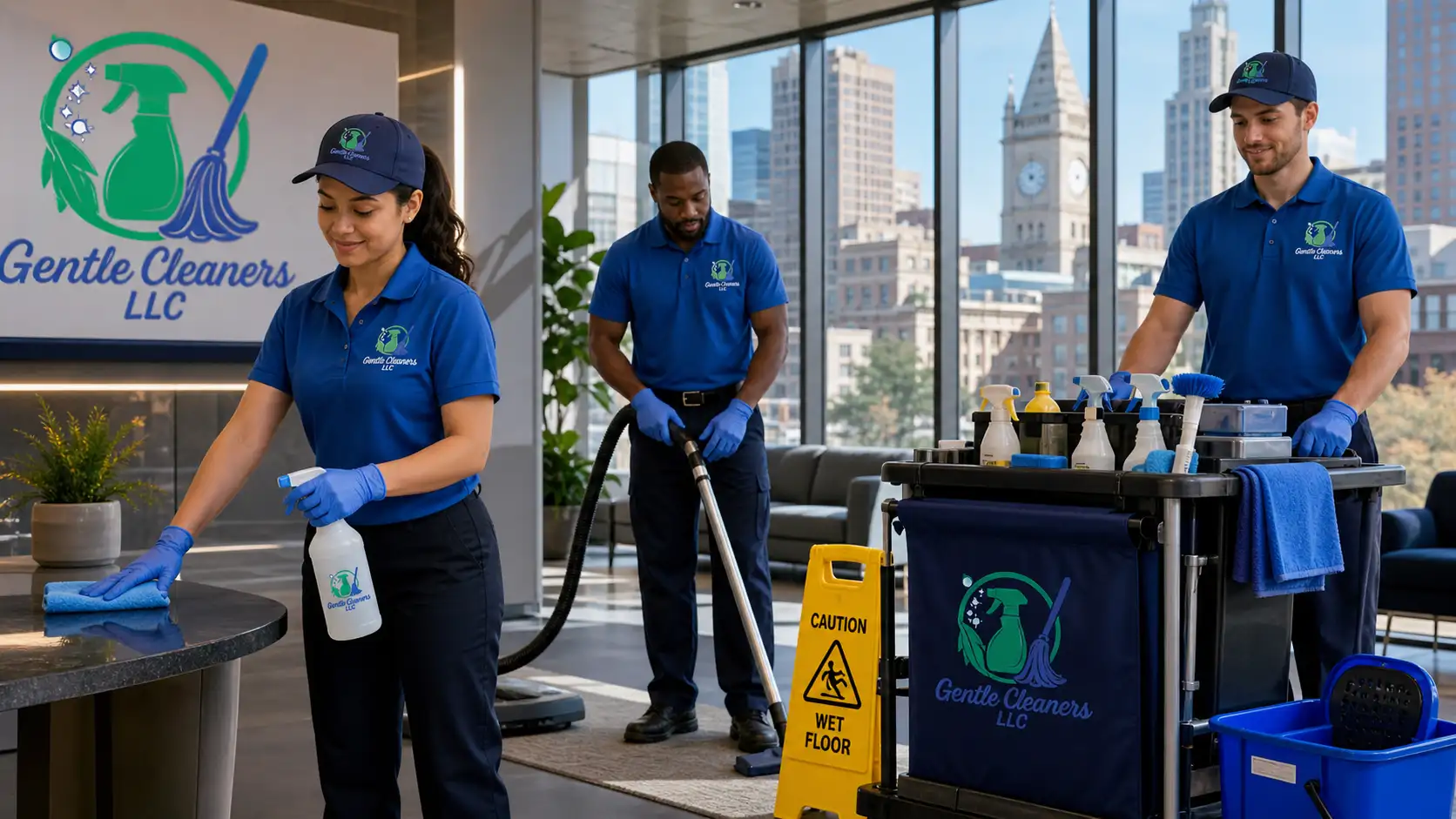
What to ask: Which specific disinfectants do you use on high-touch surfaces? Are your products EPA Safer Choice or Green Seal certified? Do you use HEPA-filtration vacuums? What's your protocol for restrooms vs. break rooms vs. open workspaces (cross-contamination control)?
Why it matters: A consumer-grade vacuum kicks fine dust right back into your air. Generic cleaners "smell clean" but don't disinfect to commercial standards. Using the same mop in a restroom and a kitchen is a real-world hygiene failure that happens more than you'd think. The right answers tell you the company has actual operational standards; vague answers tell you they don't.
For a deeper look at what separates real commercial-grade cleaning from surface tidying, see our guide to the science of commercial cleaning for Boston businesses and our overview of eco-friendly commercial cleaning.
6. Get a Detailed Scope of Work in Writing
What to ask for: a written scope-of-work document that lists every task, broken out by frequency. "Daily" tasks (trash, restrooms, vacuuming high-traffic areas), "weekly" tasks (full vacuum, dust blinds, glass cleaning), "monthly" tasks (high dusting, baseboards, vent covers), and "quarterly" tasks (deep restroom treatment, carpet extraction, fixture polishing).
Why it matters: 90% of "the cleaners are skipping things" disputes come from a vague scope of work. If the contract just says "general office cleaning," you have no recourse when restroom grout starts going gray. A detailed task-and-frequency document is the single most important document in the relationship.
What to push back on: any vendor who tells you "we'll work it out as we go." That's how a $400/month account quietly turns into a $400/month account where half the work isn't getting done.
7. Demand Pricing Transparency (and Recognize the Red Flags)
What a clean quote looks like: a flat monthly or per-visit price tied directly to the scope of work, with named add-on rates for occasional extras (carpet extraction, post-event cleanup, window washing). Both parties should be able to look at the quote and the scope and know exactly what's included.
Pricing red flags:
- A quote dramatically lower than the others. Either the scope is smaller than competitors' or the cleaner is underpaying staff (which means high turnover and inconsistent service).
- "We'll bill you for supplies." Reputable companies bake supplies into the price. Variable supply billing is a margin trick.
- Vague pricing for "deep cleans." Ask exactly what's in the deep clean and what isn't.
- No mention of an onsite visit before quoting. Square footage alone can't produce an accurate quote — building age, traffic, restroom count, and floor type all matter.
At Gentle Cleaners, our quotes follow a Pre-Estimate Onsite Visit ($100–$150) precisely because pricing without seeing the space is guessing. Frequency discounts (weekly, bi-weekly, monthly) are stated up front, not negotiated mid-contract.
8. Test Their Communication Speed Before You Hire
The simple test: when you submit the initial inquiry, how long does it take to get a response? Was the response personalized or generic? When you ask a specific follow-up question, do they answer it directly or pivot to a sales pitch?
Why it matters: communication during the sales cycle is the best communication you'll ever get from this vendor. If responses take three days now, expect five days when there's a problem and they have your money.
What to look for: a clear answer on response-time SLAs. ("We respond to client requests within 24 business hours; urgent issues within 2.") A direct phone number for the account manager, not just a generic info@ email. A documented escalation path if your usual contact is out.
9. Ask How They Run Quality Control
What to ask: Who inspects the work? How often? Is there a written inspection checklist? Do supervisors visit accounts on rotation? How are issues logged and resolved? Is there a digital system you can see, or is it tribal knowledge?
Why it matters: the difference between "we hope our cleaners do good work" and "we systematically inspect and correct" is the entire ballgame. The first model relies on the individual cleaner's diligence. The second model produces consistent quality even when a cleaner has a bad week or someone new is covering the route.
Bonus question: "What happens when we report a missed task?" Listen for the timeline. A serious operator says something like "we're back on-site within 24 hours to address it, and we credit the visit if it's our error." A weak operator says "we'll mention it to the cleaner."
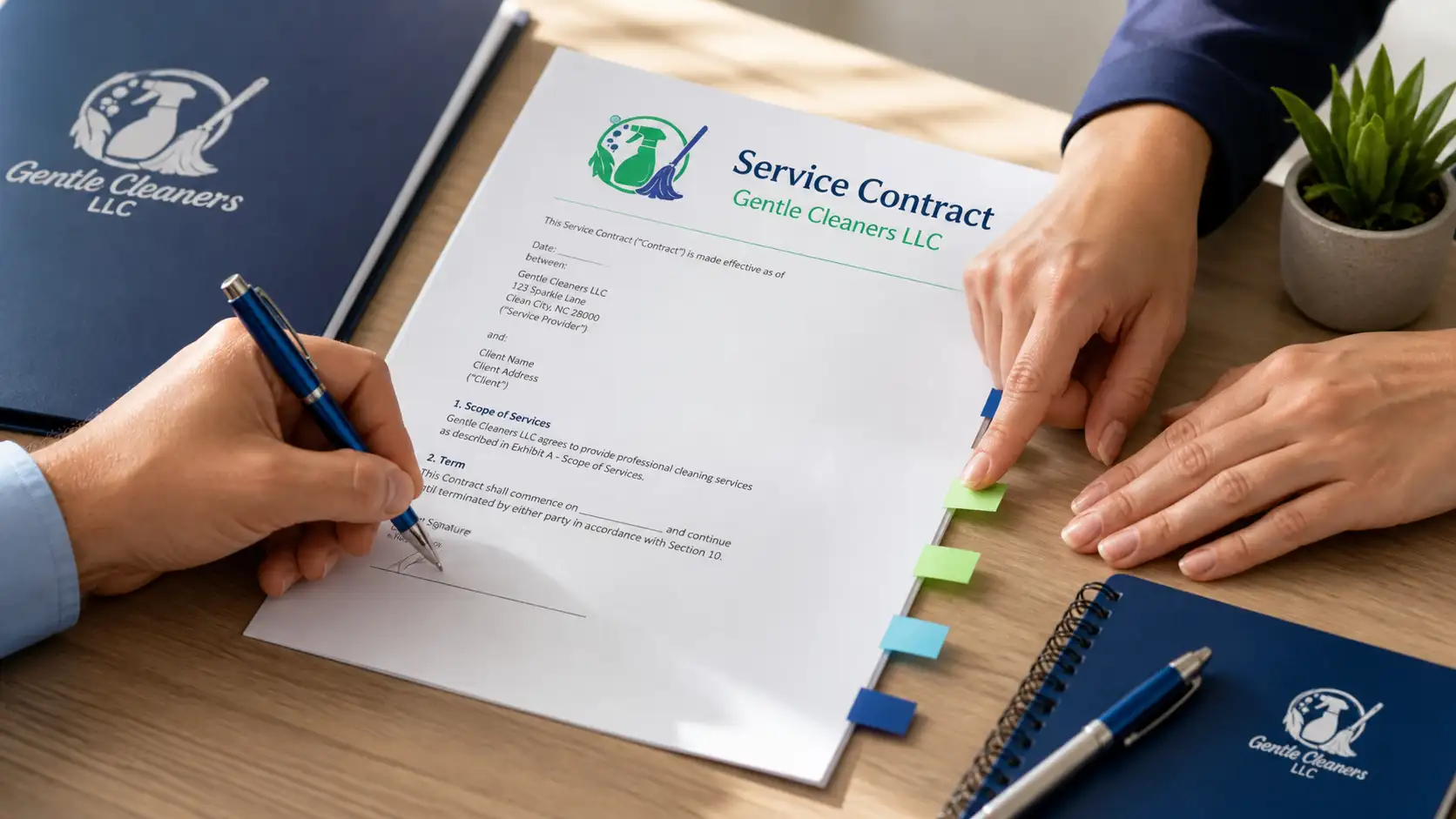
10. Read the Contract Like It's a Lease (Because It Almost Is)
Before signing, look specifically at these clauses:
- Term length and auto-renewal. Is it month-to-month, 12-month, or auto-renewing? What's the cancellation notice period — 30 days or 90?
- Cancellation triggers. Can you cancel without penalty for unresolved performance issues? What constitutes "material breach"?
- Price increases. Is there an annual escalator clause? Can prices change with notice, or are they locked for the term?
- Liability and indemnification. Who pays if a cleaner damages property or causes injury?
- Confidentiality / NDA. Critical for offices that handle client data, medical records, legal files, or financial information.
- Subcontracting. Is the company allowed to subcontract your account to a third party? If so, are the same insurance and vetting standards required?
11. Verify References From Similar Businesses
What to ask the cleaning company: three current clients of similar size and industry to yours. A 5,000 sq ft tech startup needs references from comparable accounts, not from a 50,000 sq ft warehouse.
What to ask the references: How long have you used them? Have there been service issues, and how were they resolved? Are the same cleaners assigned consistently? Have prices changed? Would you hire them again today, knowing what you know now?
The signal you want: a reference who admits there were issues but explains how they were handled. That's far more credible than a reference who claims everything has always been perfect — which usually means either (a) the reference doesn't pay attention or (b) it's the company owner's friend.
12. Trust the Walk-Through More Than the Sales Pitch
What to watch for during the onsite visit: Did they take notes or just nod a lot? Did they look behind furniture, check restroom grout, ask about high-touch surfaces, and inspect the floors? Did they ask thoughtful questions about your operations — when meetings happen, where you store cleaning supplies, what alarm system the building uses?
Why it matters: the walk-through is the only time you see them in operations mode rather than sales mode. A cleaner who looks closely, asks good questions, and points out things you hadn't noticed (a stained ceiling tile, a slow drain, a floor finish that's wearing) is showing you the level of attention they'll bring to every visit. A cleaner who walks through in five minutes and says "looks good, we can handle it" is selling you, not assessing your space.
For more on what professional cleaners actually look at, read our guide on 12 warning signs your office needs professional cleaning — those are the same signs an experienced cleaner notices on a walk-through.
Local vs. National Cleaning Companies in Boston
Both local independents and national franchises serve the Boston market. Each has tradeoffs. Here's a clear-eyed comparison:
| Factor | Local Boston Company | National Franchise |
|---|---|---|
| Decision-making | Owner is reachable; changes happen fast | Layered approvals; slower changes |
| Crew consistency | Same team typically assigned to one account | Often higher rotation as routes shift |
| Local knowledge | Knows Boston buildings, traffic, weather | Standardized playbook; less local nuance |
| Multi-state coverage | Limited to the region they serve | Single point of contact across many cities |
| Pricing flexibility | More room to negotiate scope and price | Pricing follows corporate structure |
| Accountability | Owner-operator reputation is on the line | Brand reputation, but franchise quality varies |
For a single Boston office, a strong local operator is almost always the better fit. For a 50-location national rollout, the franchise model has real benefits. Match the vendor to the actual problem you're solving.
10 Questions to Ask in Your First Phone Call
Use these as a quick-fire screening list before you commit to an onsite visit. Most companies will fail at least one of them, and that's useful information.
- Can you email a current Certificate of Insurance with our company added as additional insured?
- How long has the business operated under its current ownership?
- Are your cleaners W-2 employees or 1099 contractors?
- Do you run background checks before hire? What's your retention rate?
- Will the same crew be assigned to our account each visit?
- Can I see a sample scope-of-work document before we sign?
- What's your standard response time for service issues?
- What's the cancellation notice period in your contract?
- Do you subcontract any accounts? If so, under what conditions?
- Can you provide three references from clients of our size and industry?
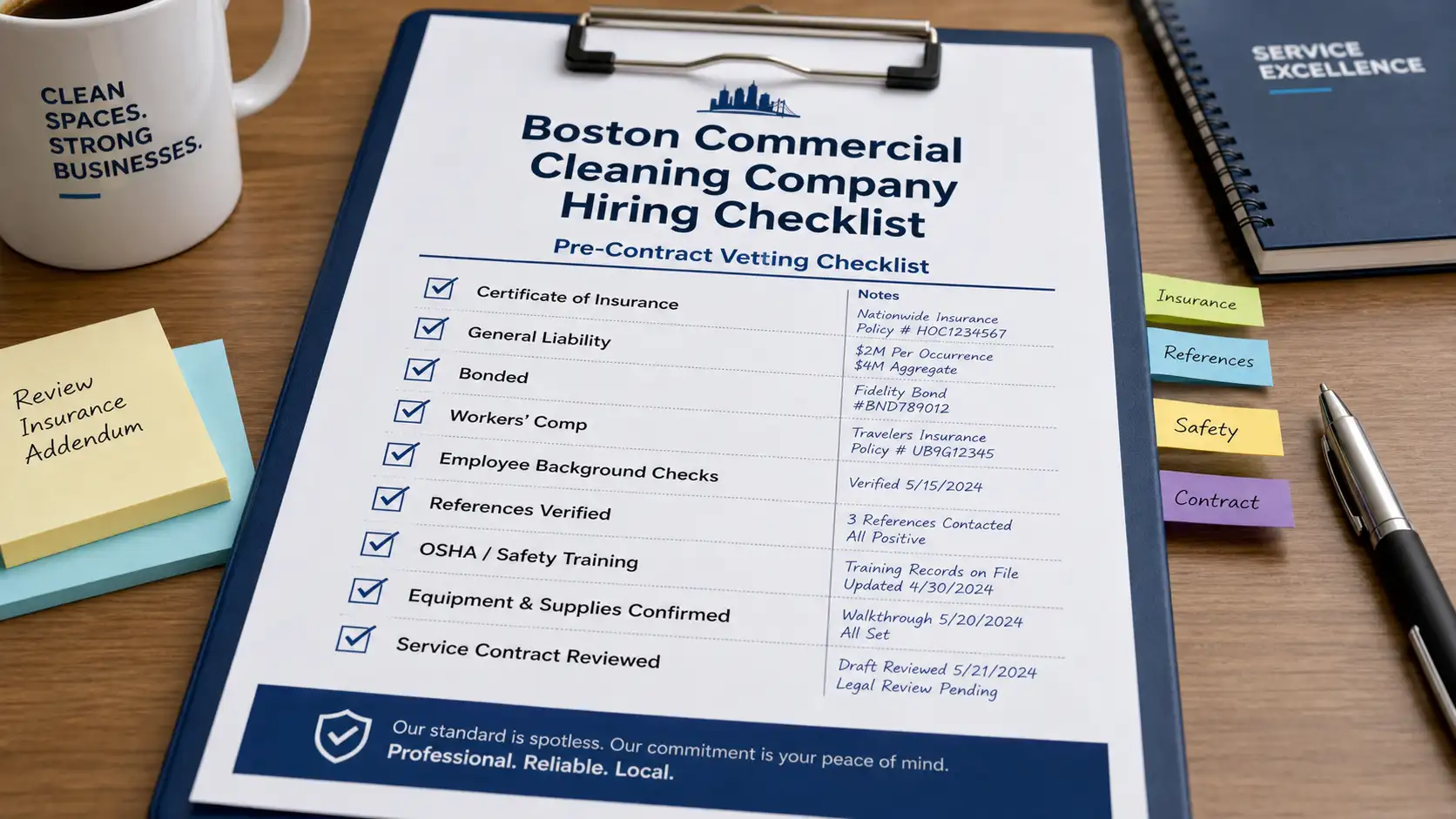
Final Vetting Checklist Before You Sign
Once you've narrowed it to your top one or two companies, run this final pass before signing anything:
- ☐ Current Certificate of Insurance received and verified
- ☐ Workers' compensation confirmed for all on-site staff
- ☐ Bond in place covering theft and dishonesty
- ☐ Massachusetts business filing in good standing
- ☐ At least 5 detailed Google reviews from real local clients
- ☐ Written scope of work with daily / weekly / monthly / quarterly tasks
- ☐ Pricing structure clear, with frequency discounts in writing
- ☐ Onsite walk-through completed by the company
- ☐ Three references called and at least two responded positively
- ☐ Contract terms reviewed (term, auto-renewal, cancellation, liability, NDA)
- ☐ Direct point of contact named (phone + email)
- ☐ Quality control / inspection process documented
If you can check every box, you're hiring with eyes open. If two or more boxes are still empty, slow down and finish vetting before you commit. A bad cleaning contract is much harder to exit than it was to sign.
Next Steps
Once you have a shortlist, the right move is an onsite visit, a written scope of work, and a transparent quote — in that order. Skipping any of those steps is how businesses end up locked into contracts that don't fit their actual needs.
For Boston-area businesses comparing options, our team at Gentle Cleaners LLC follows this exact playbook in reverse — meaning every prospective client gets a documented onsite visit, a written scope, transparent pricing, and a contract you can actually read. We serve Boston, Cambridge, Quincy, Weymouth, and the broader Greater Boston area.
For more decision-stage reading, see our guides on how often offices should be cleaned, signs your office needs professional cleaning, and our overview of commercial cleaning services in Boston.
Ready to Choose the Right Cleaning Partner?
Gentle Cleaners LLC is a Boston-based commercial cleaning company serving offices, professional firms, and commercial facilities throughout the Greater Boston area. We're insured, every cleaner on our team is background-checked, and we're happy to walk through any item on this checklist with you before you sign.
We start every relationship the same way: a Pre-Estimate Onsite Visit ($100–$150, applied to your first service if you sign up), a written scope of work, and a transparent quote. No vague pricing, no auto-renewal traps, no contracts you can't read.
Call us: (781) 901-5590 or (781) 927-4281
Or request a consultation online — we respond within 1–2 business days.
Comparing options? Bring this checklist to every walk-through. The company that earns the contract should be the one that answers every question without flinching.
Latest Articles
 Office Tips
What Your Office Restroom Says About Your Business: A Boston Commercial Restroom Cleaning Guide
June 25, 2026
•12 min read
 Seasonal Tips
Summer Office Cleaning Checklist: Keeping Your Boston Workplace Fresh All Season
June 18, 2026
•11 min read
 Buyer's Guide
How Much Does Commercial Cleaning Cost in Boston? 2026 Pricing Guide
May 22, 2026
•14 min read